
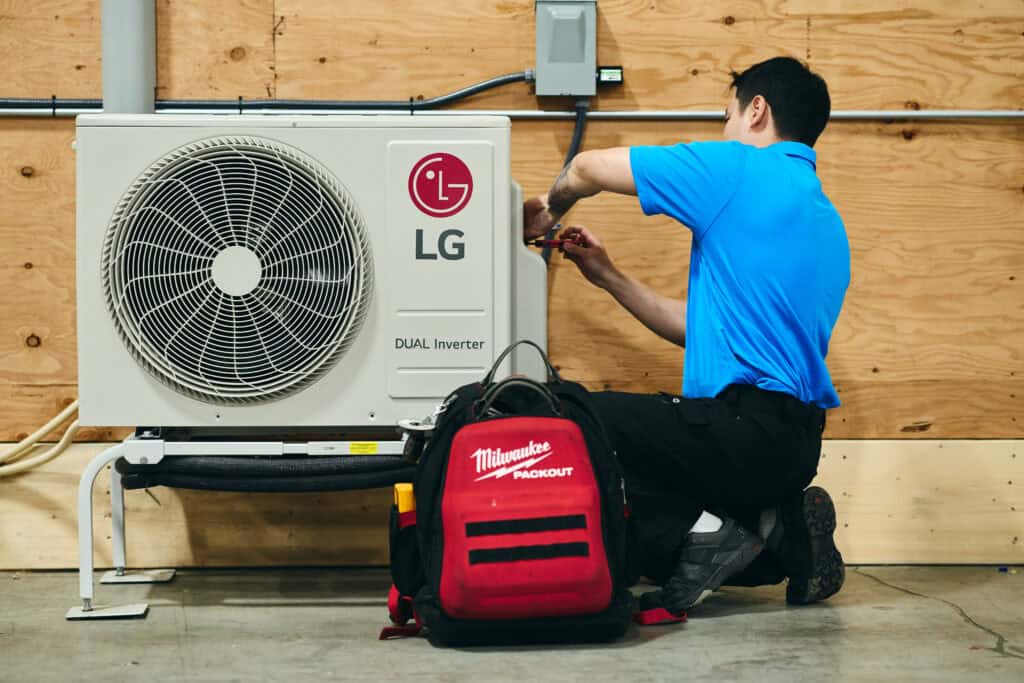
Yes. A mini split is an air-source heat pump, and homeowners ask “is a mini split a heat pump?” so often because the two terms describe different things. “Heat pump” describes how the equipment works: it moves heat rather than making it. “Mini split” describes how the equipment is built: it delivers heating and cooling directly into rooms without ductwork.
Both use an outdoor condenser and an indoor unit, and both move warmth instead of burning fuel or running electric heat coils. In summer, the process reverses, and the same equipment cools the house. So when you plan heating and cooling upgrades in Weymouth and Greater Boston, you are not choosing between two heating methods. You are choosing between ducts hidden inside the walls and ductless indoor heads mounted in the rooms themselves.
Is a Mini Split a Heat Pump? Clearing Up the Confusion
Much of the confusion comes from comparing mini split vs heat pump options as if they were rival products. A heat pump is any refrigeration system that transfers heat between indoors and outdoors. In winter, it extracts warmth from the outdoor air and brings it inside. In summer, it pulls heat out of the house and pushes it outside.
What Is a Mini Split?
To understand what a mini split is, look at its parts. The system connects an outdoor condenser to one or more indoor air handlers, linked by a compact bundle of refrigerant lines, power wiring, and drain tubing.
A ductless heat pump delivers warm or cool air directly into each room. With no ducts involved, it avoids the energy that ducted systems lose through leaky joints and uninsulated runs in attics and basements. Older marketing often presented mini splits and heat pumps as different appliances, which is where the question comes from. In practice, every ductless mini split is a heat pump without the ductwork.
Evaluating Ducted vs Ductless Mini Split Options for Your Home
Both systems share the same refrigeration foundation, so comparing a ducted vs ductless mini split comes down to your house. The decision turns on existing construction, how much installation disruption you can live with, and how you want to control room temperatures.
The Impact of Existing Ductwork
Does your home have solid ductwork from an old forced-air furnace? If so, a centrally ducted heat pump is a clean replacement. Technicians connect an indoor air handler directly to your existing duct network.
Many New England homes are heated by boilers feeding cast-iron radiators or steam pipes, and those houses have no ductwork at all. Adding sheet metal means cutting into ceilings, dropping soffits, and opening historic plaster walls. Ductless systems avoid that. Installers drill a small opening through an exterior wall for the line set, which protects the original architecture while adding modern heating and A/C.
Scaling Comfort With a Multi-Zone Mini Split
Some people assume ductless units only work for single rooms like additions or converted attics. A multi-zone mini-split connects one outdoor condenser to several indoor air handlers, and each one runs on its own thermostat.
That lets family members set different temperatures in bedrooms, kitchens, and home offices. If the second floor gets hot in July, you can cool those bedrooms without freezing the ground floor.
Selecting the Right Approach for Year-Round Comfort
Choosing between ducted and ductless equipment means looking at how you actually live in the house. Neither system fits every home, since floor plans and airflow needs vary from one property to the next.
Room-by-Room Control and Efficiency
Central ducted systems run off one main thermostat. When one room takes strong afternoon sun, the others often end up chilly, and a single-zone ducted system has a hard time balancing that.
Ductless systems send refrigerant to each room based on what that room needs. Their inverter compressors adjust speed continuously instead of switching fully on and off, which keeps temperatures steady and avoids wasted energy. You can turn heating or cooling down in an empty guest room while the main living spaces stay comfortable.
Installation Disruption and Aesthetics
Retrofitting ductwork can take weeks of framing, drywall repair, and painting. Ductless setups usually install in a few days with minimal structural changes.
Some homeowners prefer hidden equipment and standard grilles. Others prefer the quiet operation and room-by-room zoning of ductless wall or ceiling units. Once you know a mini-split is simply a heat pump in a different form, the choice comes down to which physical design suits the house.
Finding the Right Heat Pump Configuration
If your home already has reliable ductwork, a central ducted heat pump is a practical upgrade for year-round heating and A/C. If your home has no ductwork, or has stubborn hot and cold spots, a multi-zone ductless system gives you targeted comfort without tearing into historic walls.
An in-home evaluation with an experienced technician is the most reliable way to match the equipment to your layout.
Schedule a Home Comfort Walkthrough With New England Ductless
Our licensed heating and cooling technicians help homeowners across Weymouth, the South Shore, and Greater Boston find the right heat pump configuration for their homes. Contact New England Ductless to schedule an in-home walkthrough and review upfront quotes for your next heating and cooling upgrade.